When applications stop getting replies, the standard advice is to send more because "it's a numbers game." I would do something slower first: read ten postings for the role you are applying to, with a pen, and write down for each one the skills it marks required and which of those your CV shows in so many words.
It takes about an hour and in our experience the pattern shows by the fourth posting, and it is one of these three.
Pattern one: the level is wrong
Postings carry a level, read from the job ad title and the text. For Software Engineer, the largest role we track, the 7,982 postings in the 180 days to 20 October 2026 split 35% senior, 31% mid, 15% staff, 9% principal, 6% lead, 3% junior, 1% director or above. The median posting, of the 5,870 that state a number, asks for 5 years.
If your CV reads as mid-level and you are applying to senior postings, silence is the expected result. The reverse also happens: a senior engineer applying to mid-level postings reads as a flight risk or a salary problem, and gets the same silence for a different reason.
The fix is to apply at the level your evidence supports and to make that level legible in the first three lines. "Led" and "owned" are level words. So are the numbers: team size, system scale, budget. If your CV has none of them, the reader assigns a level for you, and it is usually lower than you meant.
Pattern two: the quiet skills are missing
Every skill in a posting carries two numbers: how many postings name it, and how often, when named, it is marked required rather than nice to have. The second number is where applications go to die.
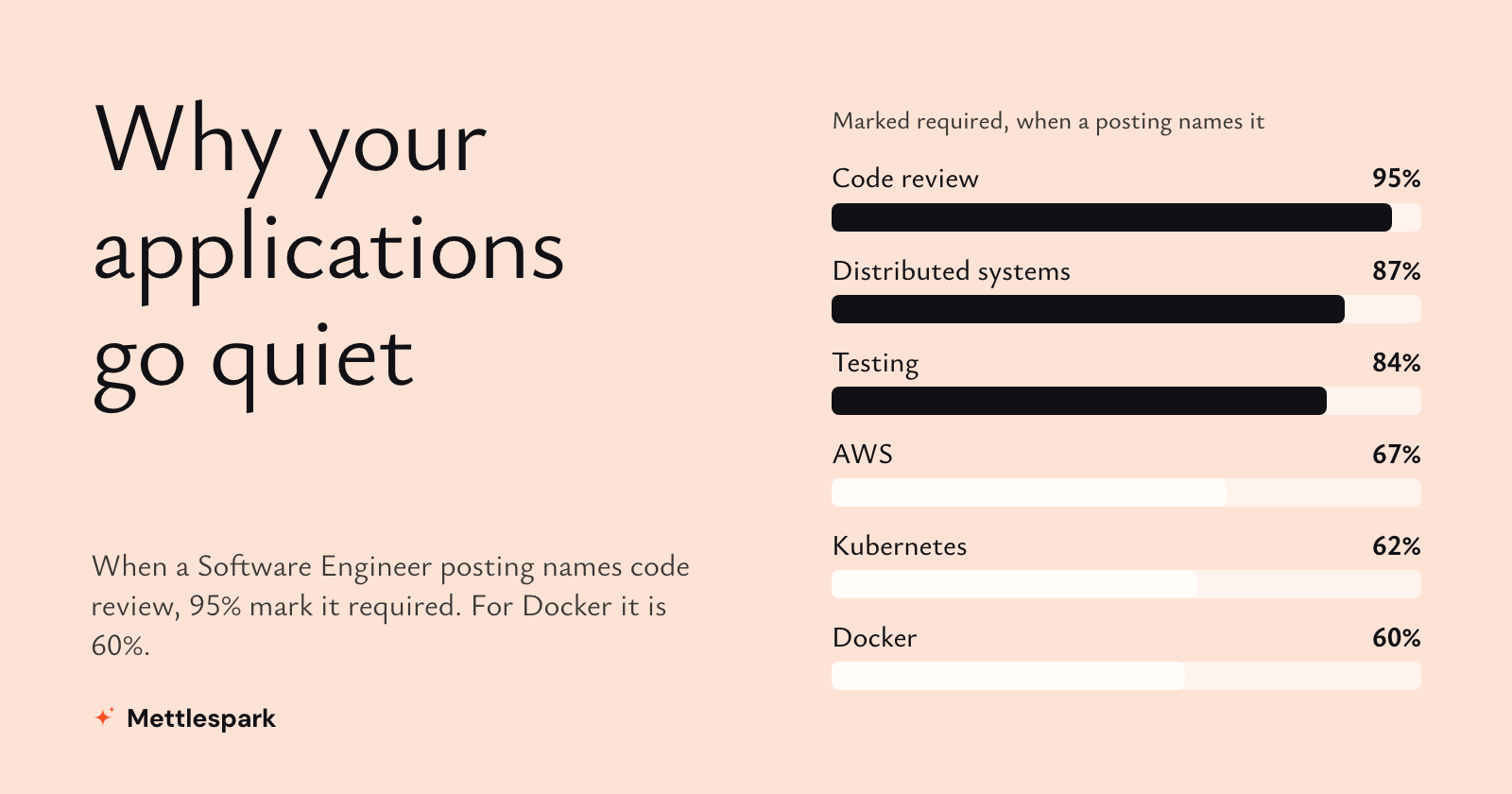
For Software Engineer postings: code review is named in 32% and required in 95% of those. Testing, 35% and 84%. Distributed systems, 39% and 87%. Now the flashier ones: Docker, 23% and 60%. Kubernetes, 28% and 62%. AWS, 34% and 67%.
Read that as a hiring manager. A third of them put Docker in the posting, but a third of those would hire without it. Almost all who ask for code review mean it. Yet CVs lead with the container stack and never mention a review they ran, a test suite they built or an on-call rotation they held, because those feel like plumbing. To the person reading, the plumbing is the job.
The same holds in the data roles. In Data Engineer postings, ETL is named in 83% and required in 97%; data modelling 59% and 95%. Kafka is named in 25% and required in only 52%, and it is falling about 1.9 points of share a month. In Machine Learning Engineer postings, ETL is 28% and 92% required; AWS is 34% and 67%.
The fix: for each posting, rank its required skills by that second number, and make sure the top three appear in your CV's first half with evidence. Our role pages show both numbers for every skill.
Pattern three: the skill is there but the evidence is not
"Python" in a skills list is a claim. "Cut a nightly batch from 40 minutes to 6 by moving the join into Python and batching the writes" is evidence. A reader who has seen a hundred of the first will stop at the second.
Our methodology page puts the limit on postings plainly: they are what employers ask for, not who they hire. The posting is the question; your CV is the answer; and an answer that repeats the question's nouns without a result (evidence) does not score.
The fix is mechanical and a little dull. For each bullet: what was the input, what did you do, what changed, by how much. If you cannot find a number, the bullet moves down. If you cannot find a number for a whole skill, the skill is not a CV problem. It is a gap, and it belongs in your learning plan rather than in a skills list where it will be tested in the first interview.
Reading your gap properly
The pen method works. It has two weaknesses: ten postings is a small sample, and you will unconsciously pick the ten you like.
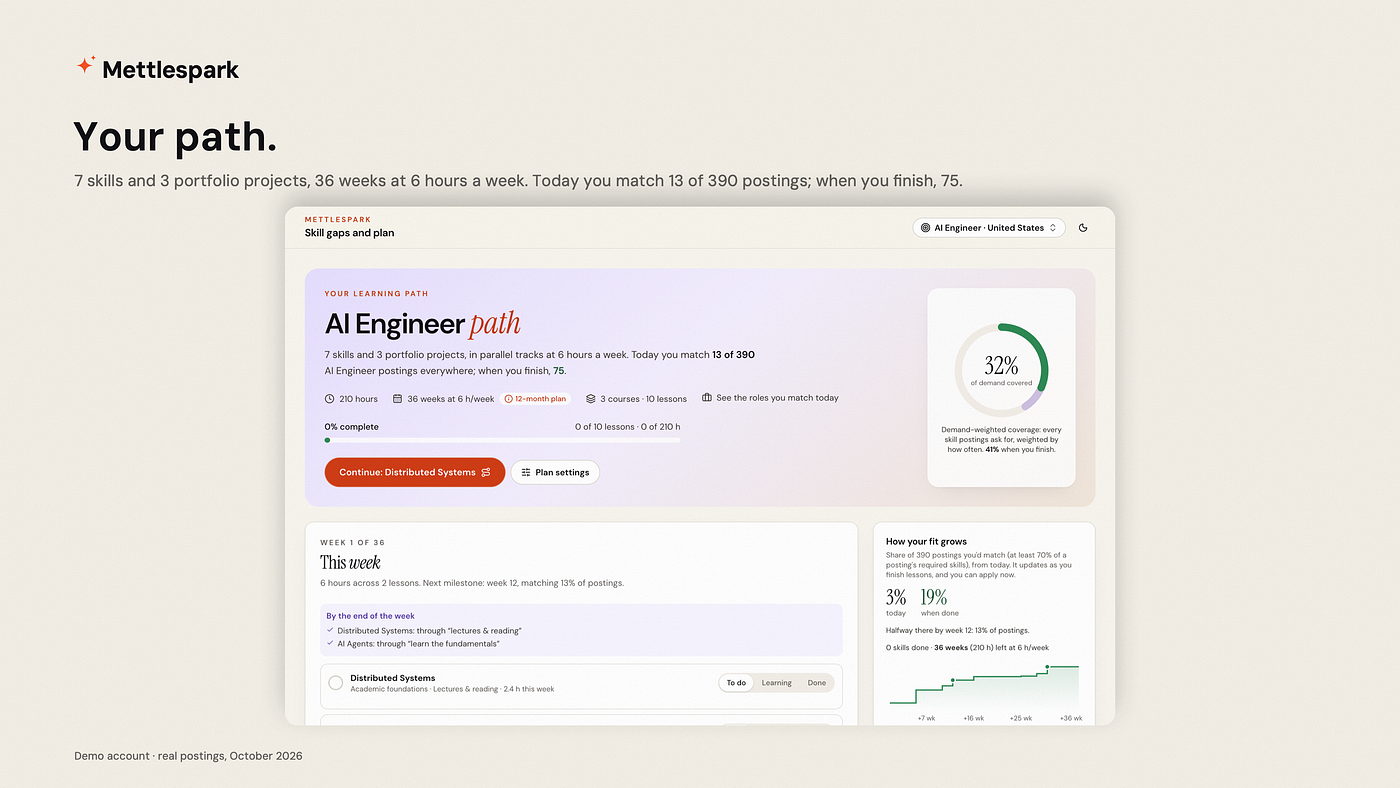
The way around both is to read every posting for the role at once and let the counts do the ranking. That is what a fit number is: take all the postings for your target role, weight each skill by how many name it, read your CV for the skills it shows, and compute the share of weighted demand you cover. The remainder is a list, ranked, with the top item being the skill the most postings ask for that your CV does not show.
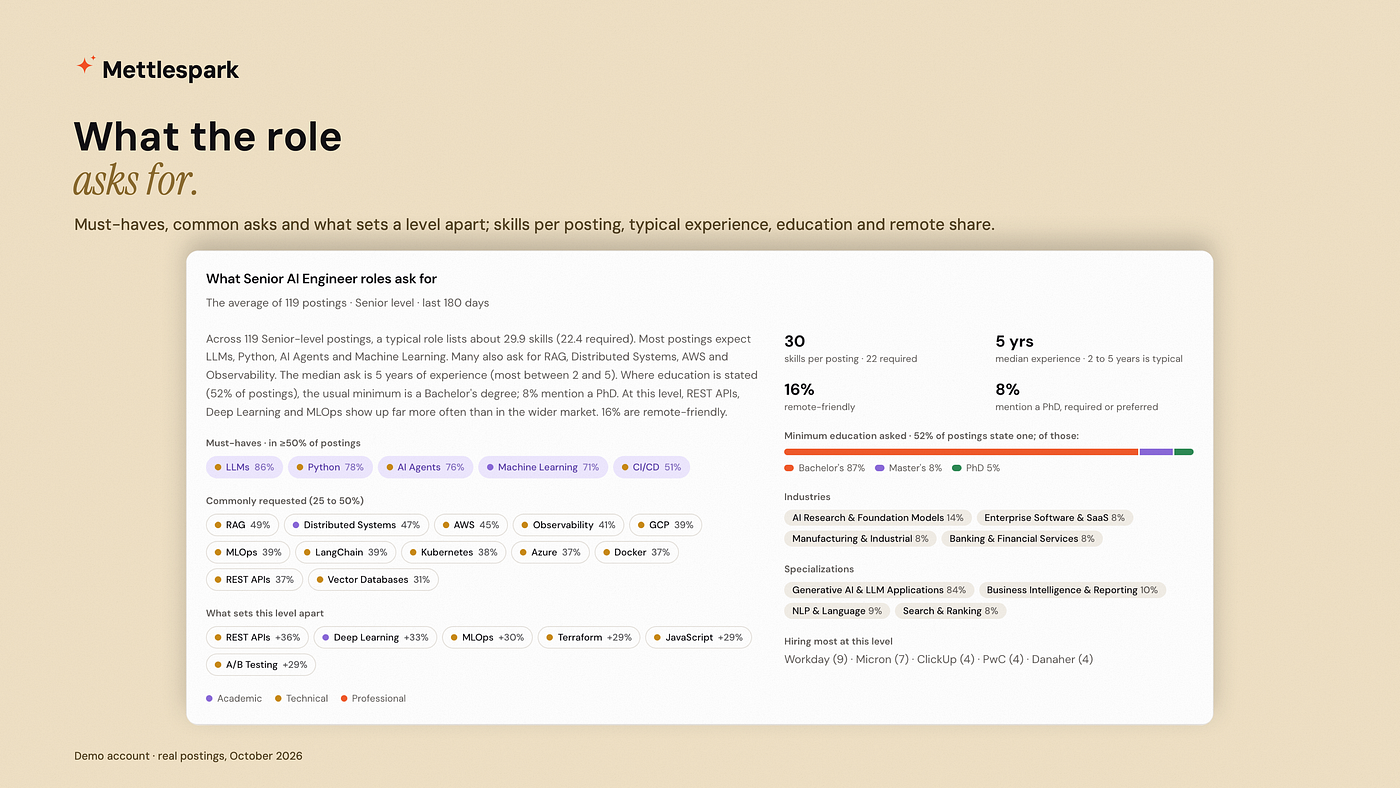
On the Mettlespark features page there is a sample account, Ryan, a Python and Go engineer moving into AI engineering (he is fictional; the postings are real, read on 14 October). His CV covered 43% of what 230 AI Engineer openings asked for. The useful part is not the 43. It is that the other 57 is ordered, so the first week of starting his learning plan is the week with the biggest effect on the number.
What to do this week
- Pick ten postings. Write the required skills in one column and tick what your CV shows explicitly.
- Check the level. If the postings say senior and your first three lines do not, fix the lines or change the postings.
- Sort the unticked skills by "required when named" from the role page. The top three go into the CV's first half with a number each, or into the plan.
- Rewrite every bullet that is a noun without a result (evidence).
- Where you don't have the skills nor the evidence, start learning.
If you would rather have the counting done across over 65,000 job postings for your role, Mettlespark reads your actual CV and ranks the gap for you. Sign up with no card and, in early access, it shows your fit for one role in a few minutes. Either way, the postings already told you why the replies stopped.
We are Mettlespark. We read the job market for the role you want and show you where you stand. How fit is computed, and the sample account mentioned above, are on our features page.
First published on Substack on November 5, 2026.