Most pieces of advice about what to learn next is written from memory. A manager remembers what their team needed. A course remembers what it was built to teach. A friend remembers the interview they had. The one source that is written down, dated, and updated every morning is the job ad, and almost nobody reads enough of them to see the pattern.
We built Mettlespark and Mettlespark AI to read and study them. Every day it fetches live job ads for technology roles from employers' own career pages and from public job boards across the United States and Canada, merges duplicates so that no employer or job posting counts twice, and reads each ad for the skills it asks for, whether each skill is marked required or preferred, the seniority wanted, and any pay the ad advertises. Right now that is over 65,000 live ads from over 9,200 employers, read against a registry of over 13,000 skill names, so that "LLM", "LLMs" and "large language models" count as one thing.
Then it does the part that matters to one person: you pick the role you want, upload the CV you have, and it reads your CV the same way it reads the ads. Your fit is a number and your knowledge gap is a list, weighted by how many employers ask. The gap then becomes a learning plan sized to the hours you have in a week.
This article is about the ads, not the app. The October report covers 46,198 tech job ads from 4,365 employers over the 180 days to 28 October, across 37 roles. Here are seven things in it that we did not expect.
1. "Entry level" barely exists in the ads
Of 12,166 Software Engineer ads in the United States, 333 are for junior roles. That is under 3%. Data Scientist: 83 of 1,942, about 4%. Product Manager: 120 of 5,220, just over 2%. Data Engineer: 42 of 1,221, about 3%. The median ad asks for four to five years of experience, and the two largest bands everywhere are mid and senior.
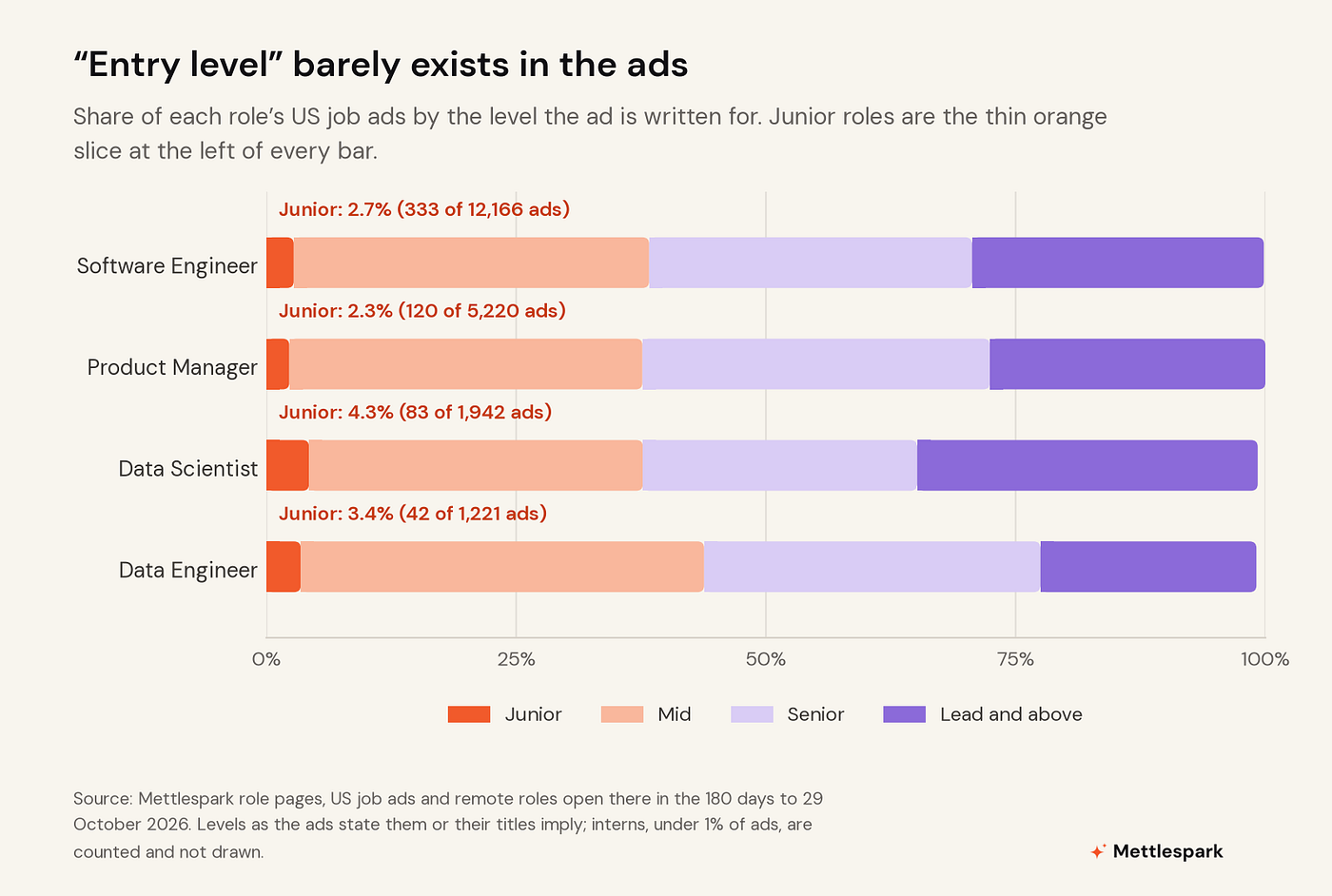
This is not news to anyone who graduated in the last two years, but the size of it is. A new graduate reading a job board is reading a market where fewer than one ad in twenty is written for them. The practical consequence: the gap between a graduate's CV and a mid-level ad is the real target, and it is a shift that needs planning for.
2. One in five ads now asks for AI agents, and the ads mean it
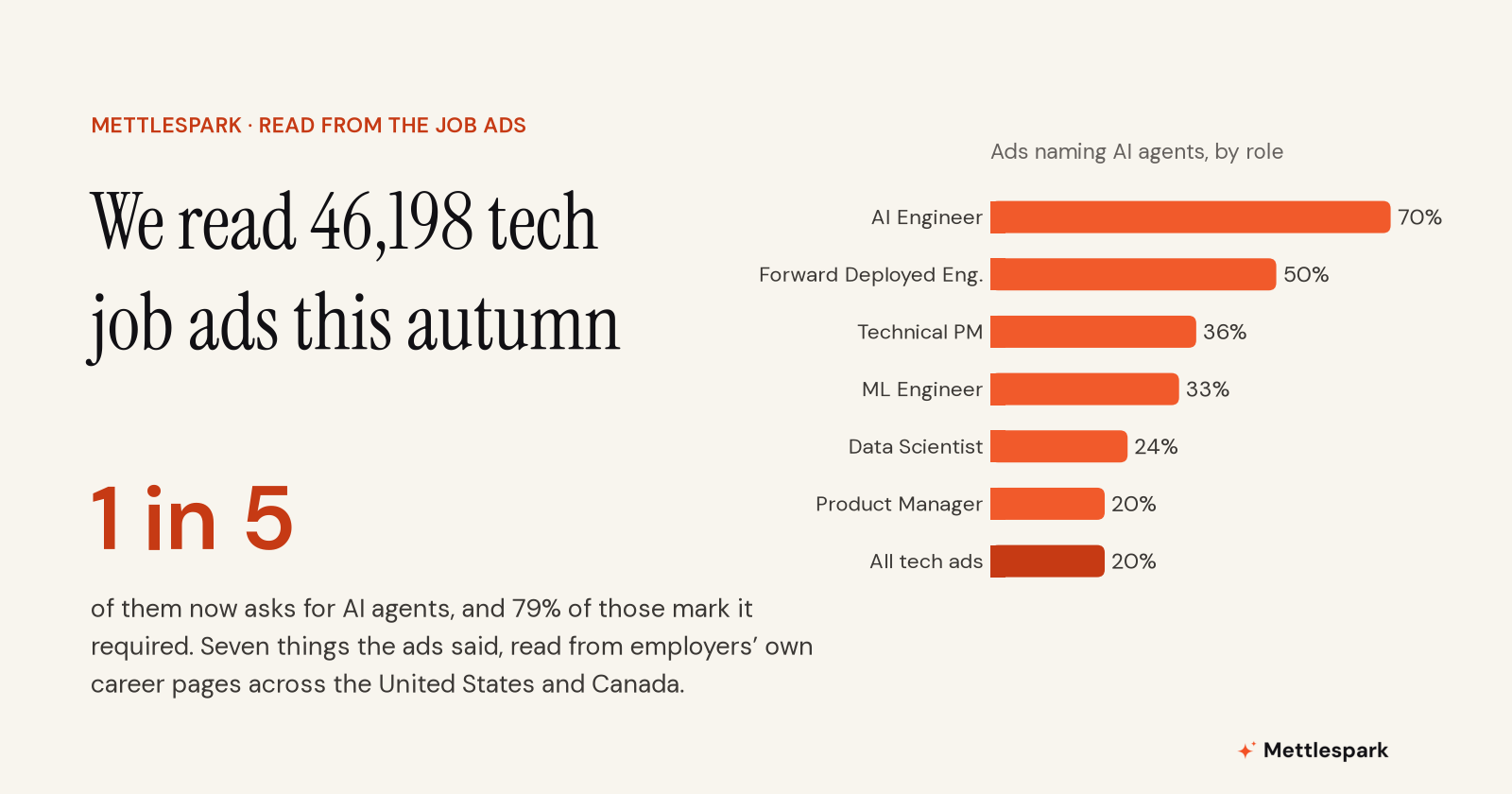
AI Agents appear in 20% of all 46,198 ads, which makes it the tenth most-named skill in the market, ahead of Azure, Kubernetes and LLMs themselves. When an ad names it, 79% mark it required, not preferred. In AI Engineer ads it is 70%; in Forward Deployed Engineer ads, 50%; in Technical Product Manager ads, 36%; in Data Scientist and Full-Stack Engineer ads, 24% each. One in five Product Manager ads asks for it, the same share as the market as a whole.
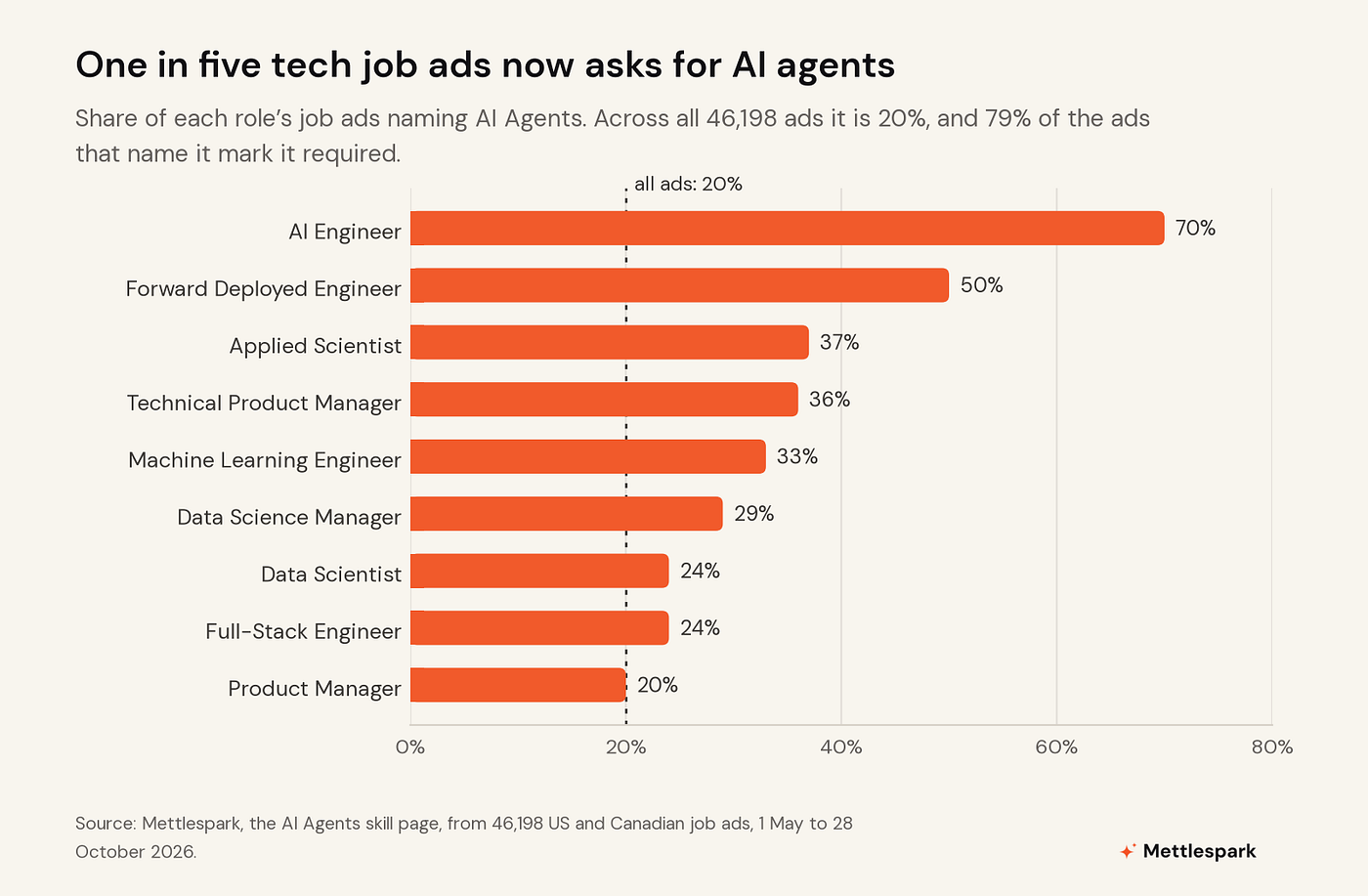
Two details say what kind of demand this is. Two-thirds of the ads naming it are for senior roles or above, so it is being asked of people expected to ship. And the industries asking most are not AI labs: enterprise software and banking tie at 11% of those ads each, with foundation-model companies at 7%.
3. The non-negotiables are the old skills
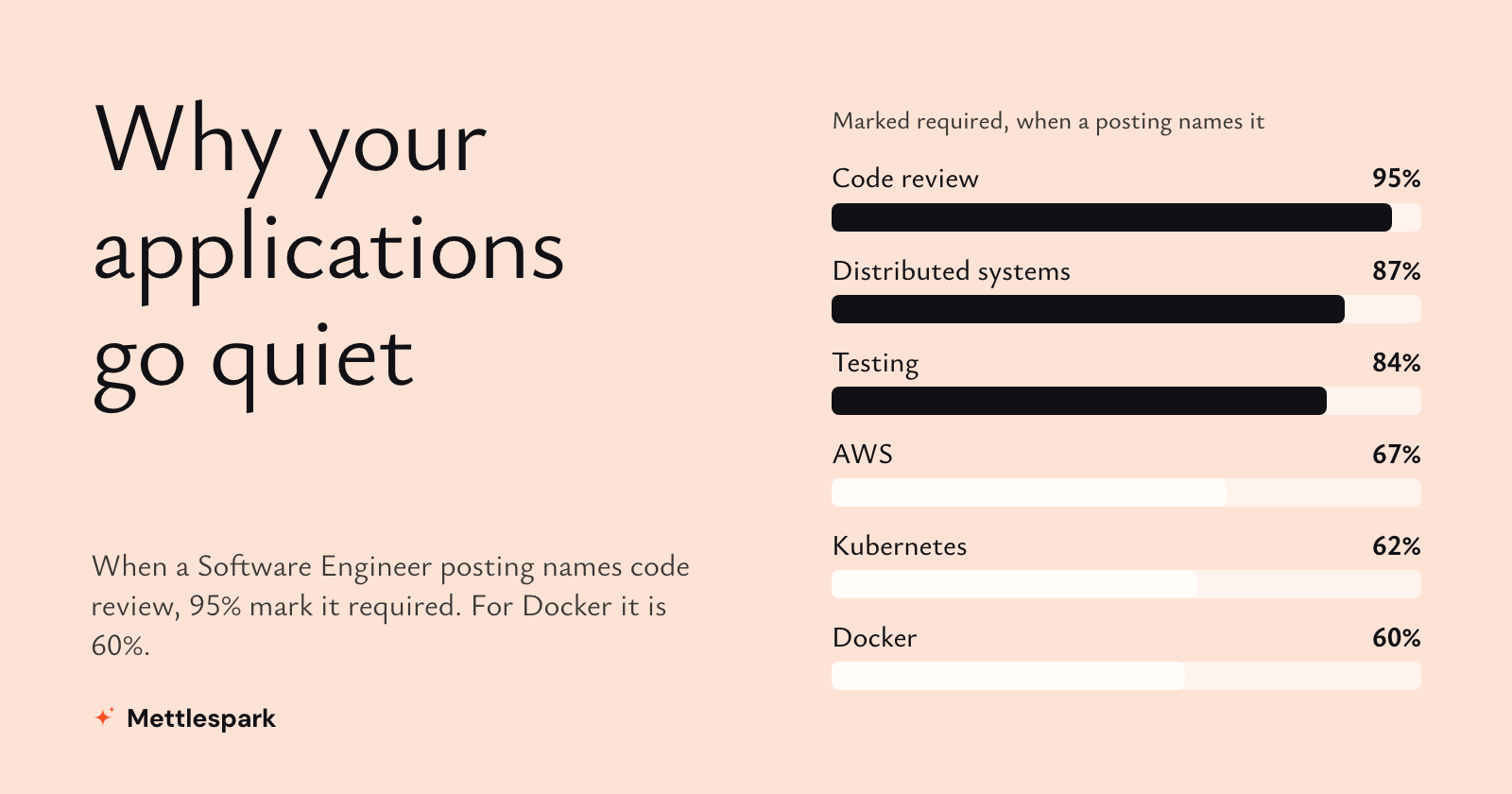
The report shows, for each skill, how often an ad that names it marks it required. Read that column and a pattern appears. Code review: 89% required when named. Distributed systems: 87%. SQL: 84%. Python: 83%. Testing: 81%. Now the cloud: AWS 71%, Azure 68%, Kubernetes 68%. Agile, 69%.
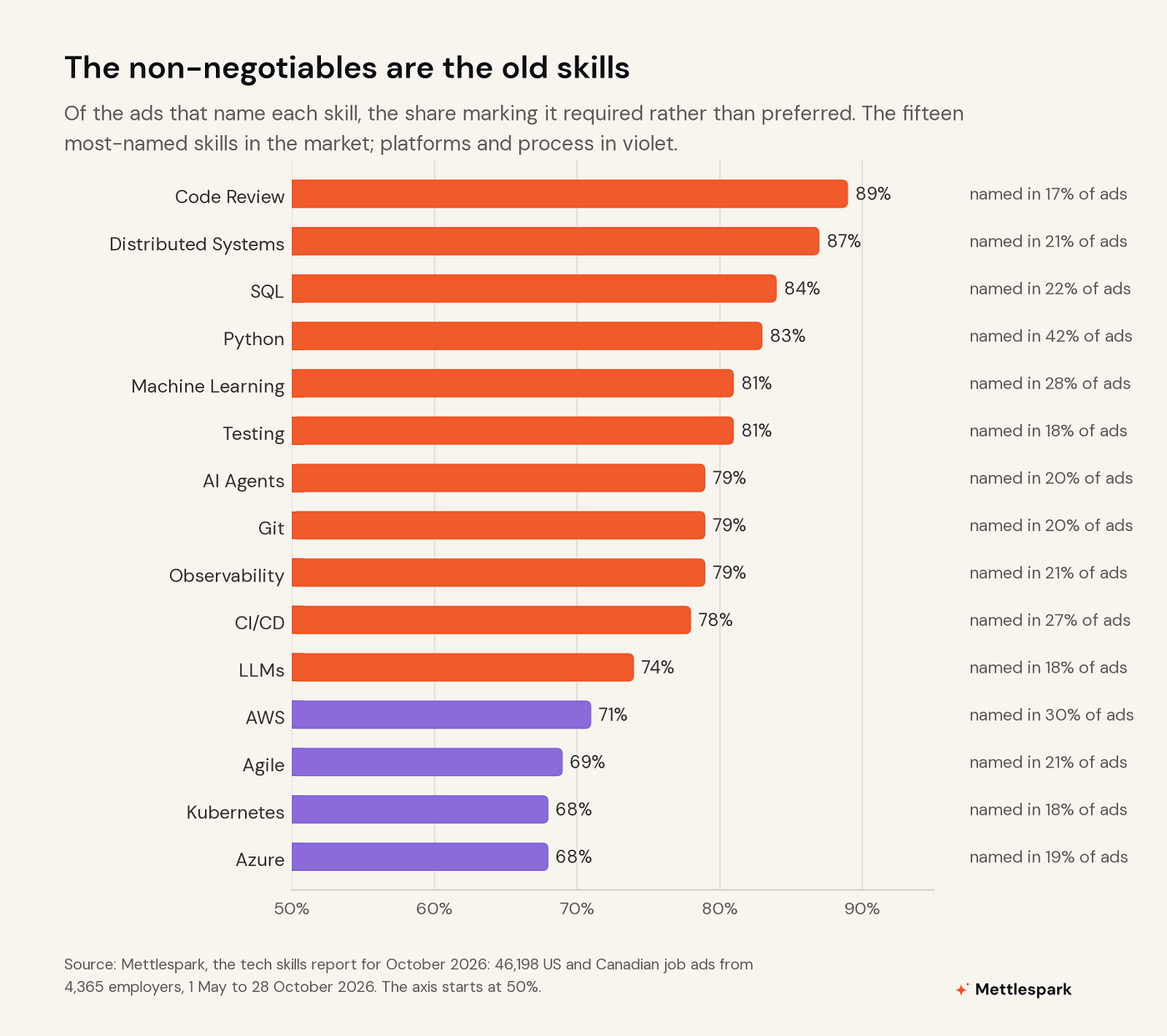
Employers write the fundamentals as conditions and the platforms as preferences. For a product manager the pattern is even sharper: Product Strategy is named in half of all Product Manager ads and required in 98% of them. If you are deciding between a week on a cloud certificate and a week on SQL, the ads have an opinion.
4. The fastest-rising skills for engineers are not tools
The report ranks skills by how fast their share of a role's ads is changing, month on month, from November 2025 to September 2026. The top of the list: Stakeholder Management in DevOps Engineer ads, up 2.8 points a month. Then AI Coding Tools and AI Agents in AI Engineer ads, each up 2.5. Then Leadership in AI Engineer ads, 2.4; Communication and Leadership in DevOps Engineer ads, 2.4 and 2.3 respectively.
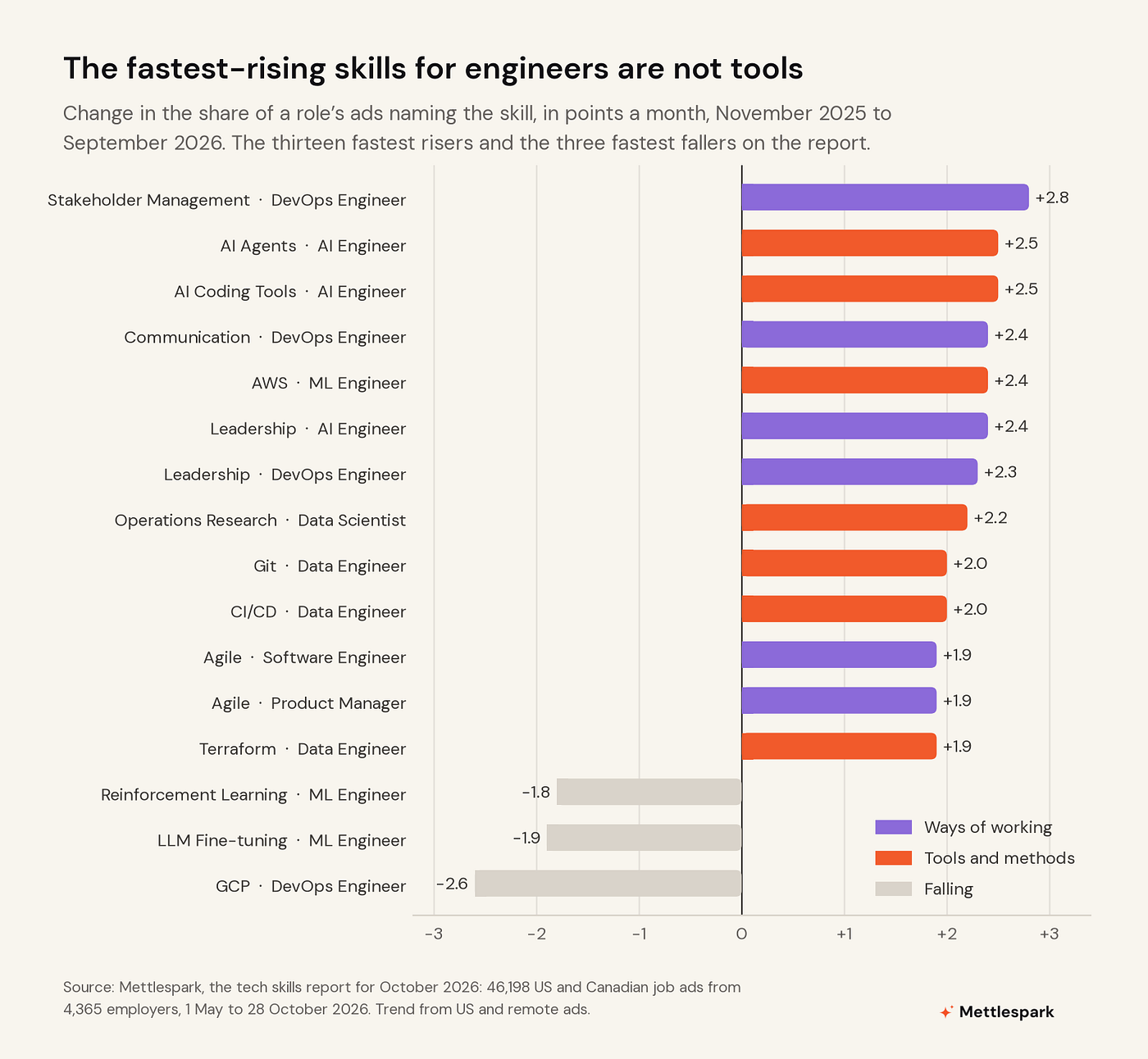
Half of the fastest risers are things nobody puts on a course list. Whatever the cause, and we would guess it is smaller teams with wider remits, the ads for infrastructure and AI roles are asking for people who can run a conversation as well as a pipeline.
5. Fine-tuning is falling while agents rise
The same ranking has a bottom. LLM Fine-tuning in Machine Learning Engineer ads is down 1.9 points a month; Reinforcement Learning in the same ads, down 1.8; GCP in DevOps Engineer ads, down 2.6, the largest fall on the page.
Put the risers and the fallers side by side and the shape of the year is clear: the market moved from training models to wiring them. That changes what an ML engineer should build to show. A year ago a fine-tuned model was the portfolio piece. Today the ads describe an agent that calls tools, is observed in production and is evaluated, which is also why Observability sits at 21% of all ads and LLM Evaluation has its own line.
6. For a data scientist, statistics is required and the cloud is optional
The Data Scientist ads are the clearest example of how to read a role page. Python is in 82% of them, Machine Learning in 81%, Statistics in 75% and SQL in 67%. Those four are the job. Then look at the required column: Statistics is required in 91% of the ads that name it. AWS is named in 26% and required in only 48% of those.
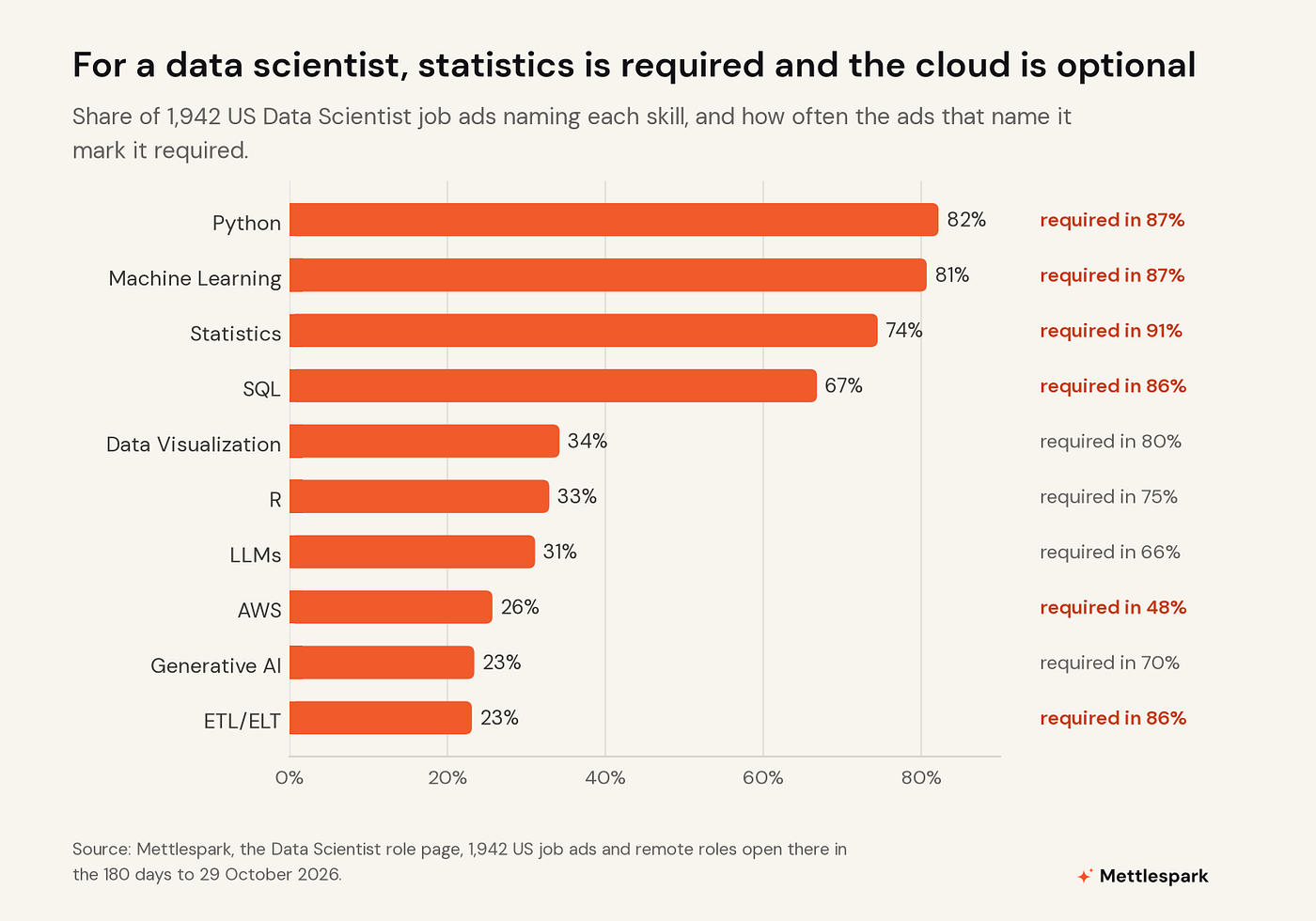
Two more lines worth a minute. R is still in a third of Data Scientist ads, which surprises people who think it is gone. And LLMs are in 31% of them, Generative AI in 23%, so the role is absorbing the new work without dropping the old. The Canadian ads for the same role have the same core, with one difference: 35% of them are remote, against 20% in the United States.
7. Remote is one ad in five, and the advertised pay is closer across roles than the folklore says
In the United States, 18% of Software Engineer ads are remote, 20% of Data Scientist ads, 23% of Product Manager ads, 26% of Data Engineer ads. The Canadian ads run higher, at least for data scientists. If you only apply to remote roles in the United States, you are reading a fifth of the market.
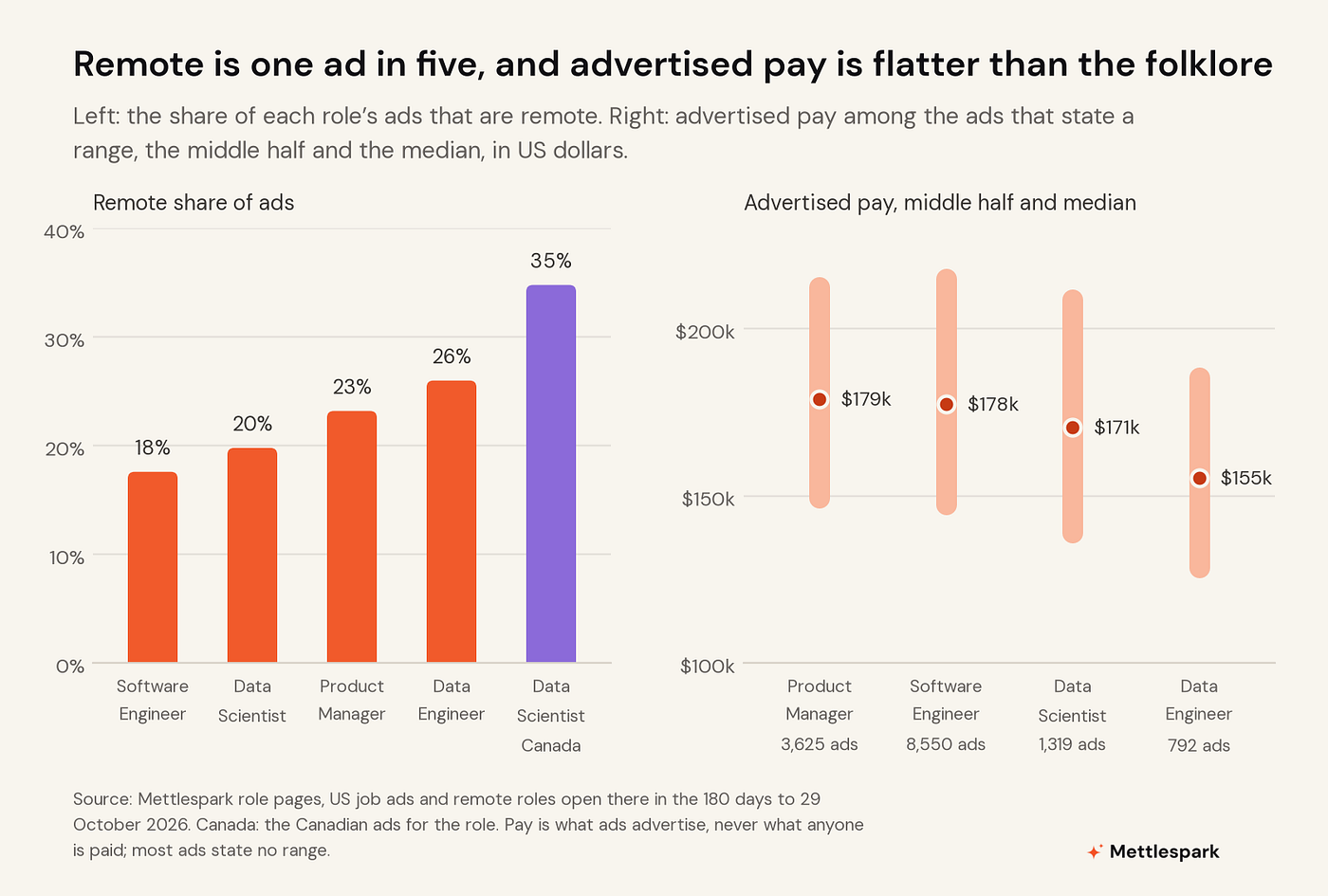
On pay, the ads that state a range tell a flatter story than people expect. Among US ads that advertise one, the median Product Manager figure is $179,050, Software Engineer $177,500, Data Scientist $170,600 and Data Engineer $155,450. These are advertised ranges, not what anyone is paid, and only some ads state one (8,550 of the Software Engineer ads do likewise 792 of the Data Engineer ads). But the spread between the four roles at the median is about 15%, which is not what common public discourse would suggest.
What you can do with this
The report, every role page and every skill page are public: the counts, the required shares, the skills that travel together and the method on one page. Start with the role you want and read its page the way this article read four of them: the top four skills are the job, the required column is the order, and the risers are next year.
If you want the personalized version for your own CV, Mettlespark reads it the same way, puts it beside the ads, and gives you your fit as a number and your gap as a ranked list, with a learning plan and materials sized to your week. That is free in early access, no card.
Disclaimer
The ads say what employers wrote. Advertised pay is what an ad says, never what a person earns, and most ads say nothing. And no count on Mettlespark is adjusted to look better: every number on a page links to the count behind it, and when the data cannot support a claim, the page says so and waits to accumulate more evidence.
We are Mettlespark. We read the job market daily for the role you want and show you where you stand: mettlespark.com, create a free account to get started!
First published on Substack on October 31, 2026.