A ghost job is an ad for a role that isn't really open. Maybe the employer is collecting CVs for later, the job depends on a contract it hasn't won, or the role was filled and nobody took the ad down. You apply, tailor your CV, write the note, and hear nothing, because there was never a seat to fill.
Most of what's written about ghost jobs is anecdote. We wanted a count. On 13 November 2026 we looked at every open tech job ad we track: 60,927 ads from 6,472 employers, read from the employers' own hiring pages, each one seen live in the week before. Then we looked for signs that an ad isn't a current opening.
The short answer
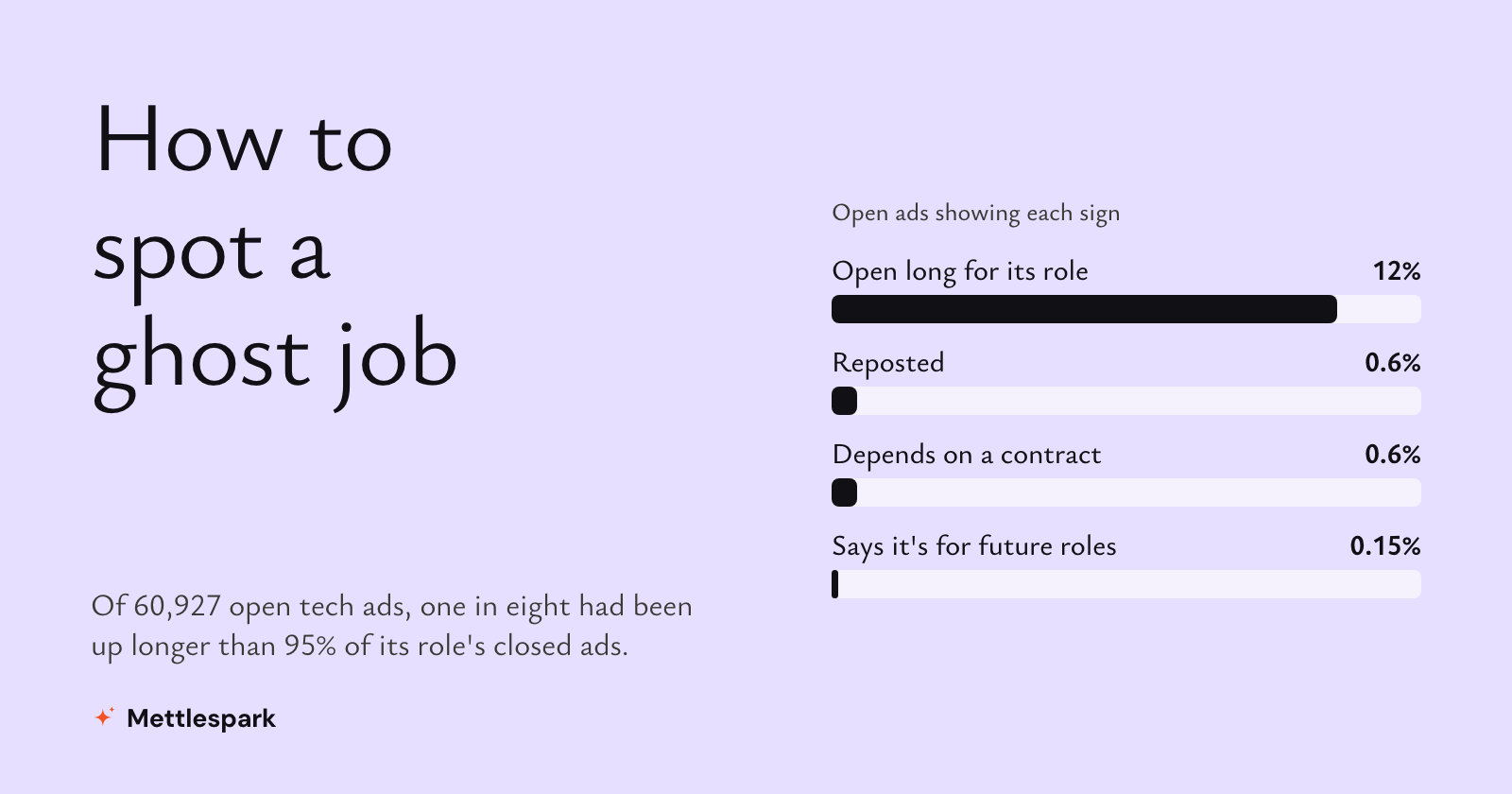
Most ads show no sign at all. The ads that say outright they aren't for a current role are rare: under 1% of the total. The common sign is age: about one open ad in eight has been up longer than 95% of the ads for the same role that have since closed, and longer than 90 days.
That doesn't make one in eight a ghost job. Some roles are slow to fill, and some employers really do hire all year. But it's where your time is most at risk, and it's easy to check before you apply.
Sign 1: the ad tells you
Some ads say in their own words that they aren't for a job open today. They talk about "proactive recruitment purposes", "building a pipeline for future openings" or "not an immediate opening".
We found 87 ads (0.15%) that say so. It's the clearest sign there is, and it's usually in the last paragraph, under the benefits and the equal opportunity statement. Read to the end before you spend an evening on a cover letter.
Sign 2: it depends on a contract or funding
Some ads say the job is "contingent upon contract award" or "contingent on funding". The role is real, but only if the employer wins the work. This is common in defense and government contracting, where firms advertise before a bid is decided so they can name the team they'd staff it with.
We found 361 ads (0.6%) at 58 employers. If you'd like to work there, apply: these can turn into offers. Just expect a wait, and keep applying elsewhere in the meantime.
Sign 3: it has been open far longer than its role usually is
Every role has its own pace. To know what "too long" means, we measured the ads that have closed, from the date the employer gave them to the last day they were listed:
| Role | Closed ads | Half closed by | 95% closed by |
|---|---|---|---|
| Software Engineer | 7,566 | 30 days | 264 days |
| Product Manager | 2,983 | 26 days | 167 days |
| Data Scientist | 1,451 | 27 days | 254 days |
| Machine Learning Engineer | 903 | 38 days | 351 days |
| Data Analyst | 884 | 16 days | 138 days |
| AI Engineer | 837 | 27 days | 171 days |
Ads that closed, measured from the employer's date to the last day seen.
Half of all data analyst ads close within 16 days, so one open for five months is unusual. A machine learning engineer ad can stay up for most of a year and still be a real search.
7,326 open ads (12%) have been up longer than 95% of their role's closed ads, and longer than 90 days. 4,014 (6.6%) have been up more than twice that long. This is the sign that also catches slow hiring, which is why we call these ads possible ghost jobs and not ghost jobs.
For scale, here is how old the open ads are:
| Open for | Share of open ads |
|---|---|
| Under 30 days | 34.0% |
| 30 to 59 days | 24.1% |
| 60 to 89 days | 11.3% |
| 90 to 179 days | 14.4% |
| 180 to 364 days | 7.3% |
| A year or more | 8.8% |
A third of what's open went up in the last month. That's where your odds are best.
Sign 4: it was taken down and put up again
Some ads disappear and come back on the same board under a new listing, which makes an old ad look new. We count it when the copies didn't overlap and at least a week passed between them.
We found 354 ads (0.6%), from about six weeks of watching. This number grows the longer you watch, so treat it as a floor.
What we didn't count
Some signs that get passed around online would have flagged real jobs, so we left them out:
- "Join our talent community": 646 ads say it, but it's a line in the employer's page template, not a statement about the job.
- "Not currently hiring": in the ads we read, it was nearly always about something else, such as candidates who need visa sponsorship.
- Several copies of the same ad: 10,629 open ads are one of several open together. That's usually hiring for many seats at once.
- No pay in the ad: a compliance problem where the law asks for it, but not a sign the job isn't there.
How to protect your time
- Check the date on the employer's own careers page, not on the board that copied it. An ad re-dated last week can still be months old.
- Favor ads under 30 days old. They're a third of what's open, and the most likely to be a seat someone is filling now.
- Read the last paragraph for "future", "pipeline", "proactive" or "contingent".
- Compare the ad's age with its role using the table above. Past the 95% line, it's worth asking before you invest an evening.
- Ask before you tailor. A short note to the recruiter or someone on the team ("Is this role still being actively filled?") costs less than a custom CV.
- Set an alert for the role, so you see new ads in their first days instead of their fourth month.
In Mettlespark
We built these four signs into Openings. An ad that shows one carries a short chip (Future roles, Contingent, Long open or Reposted), the job's panel says why in plain words, and Hide likely ghost jobs in All filters leaves them out of your list. It's free on every plan, and each sign is a fact we can show you, never a guess about the employer.
How we measured
The ads come from employers' own hiring systems, read daily; an ad counts as open if we saw it listed in the seven days to 13 November 2026. An ad's age comes from the date the employer gave it, so an employer that re-dates its ads hides their age from us too. The future-roles and contract signs are phrases in the ad's text, checked by hand against false matches ("not a narrow pipeline role" is about the work, not the hiring). The age sign compares each ad with the closed ads of the same role. Reposts need history, and we've been watching live since 4 October 2026, so that count will rise. How we count has the rest.
We are Mettlespark. We read the job market daily for the role you want and show you where you stand: mettlespark.com, create a free account to get started!