A tech job search has more parts than a CV. You need to know what employers for your role ask for, where you stand against it, what to learn first, a CV shaped for each job, a way to keep track, and preparation for the interview. Most tools do one or two of these well. One does all of them.
We make Mettlespark, so it's first on this list, and we say why below. Everything said about the other four comes from their own websites, read on 13 November 2026.
1. Mettlespark: the whole search, built from the job ads
Best for: anyone aiming at a tech role in the United States or Canada, from a first job to a director role.
Mettlespark starts where a job search should: with what employers actually ask for. It reads employers' job pages and public job boards every day, and counts, role by role, the skills job ads ask for, how often they're required, what they pay and how that has moved since 2021. Its public figures come from 52,847 tech job ads by 4,990 employers in the 180 days to November 2, 2026, and How we count shows the method.
Everything else in the app works from that count:
- Your fit, from your own CV. Upload it in Word, PDF, text or Markdown and every page shows which of the skills employers ask for your CV covers and which it doesn't. For Data Scientist, that's Python in 83% of job ads and Machine Learning in 81%, checked against what you've actually written.
- A plan for the gap. Your missing skills, the most asked-for first, prerequisites before what builds on them, week by week at the hours you have, with the best existing courses and docs and a short check to close each step.
- A CV for each job, in your own file. The editor works on your Word or PDF CV and keeps its layout, makes a tailored version for each job you save, and waits for you to keep or undo every AI edit.
- Openings ranked by your fit, and every application with the CV you sent and each step to an offer.
- Interviews prepared for one job, from its ad and your CV: the questions to expect and how to answer, how the company interviews, and practice with feedback.
- People on the same path: posts by role, study groups and challenges.
- Where you already are: a free Chrome extension on the major hiring systems' job pages, and Mettlespark inside Claude and ChatGPT.
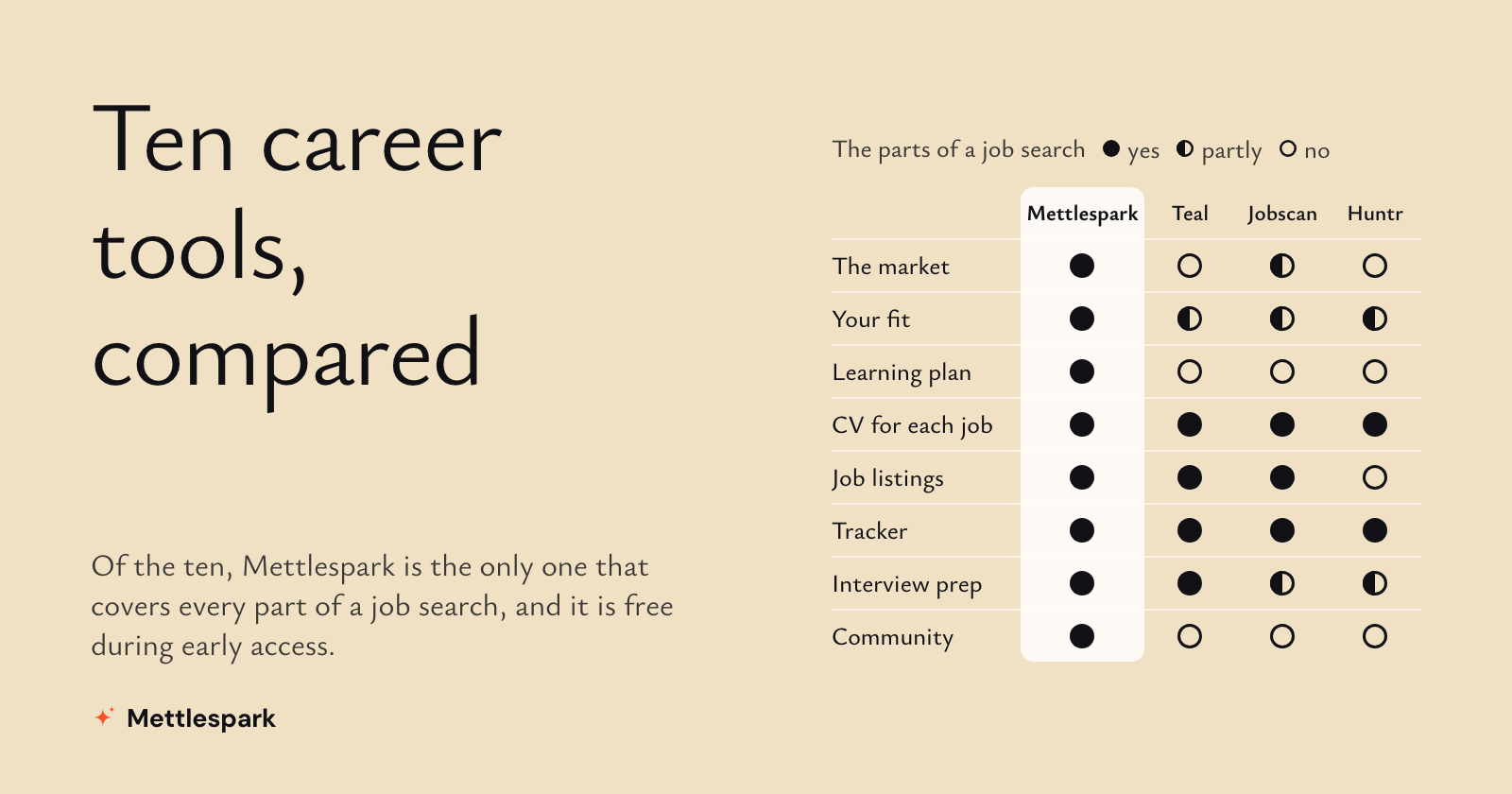
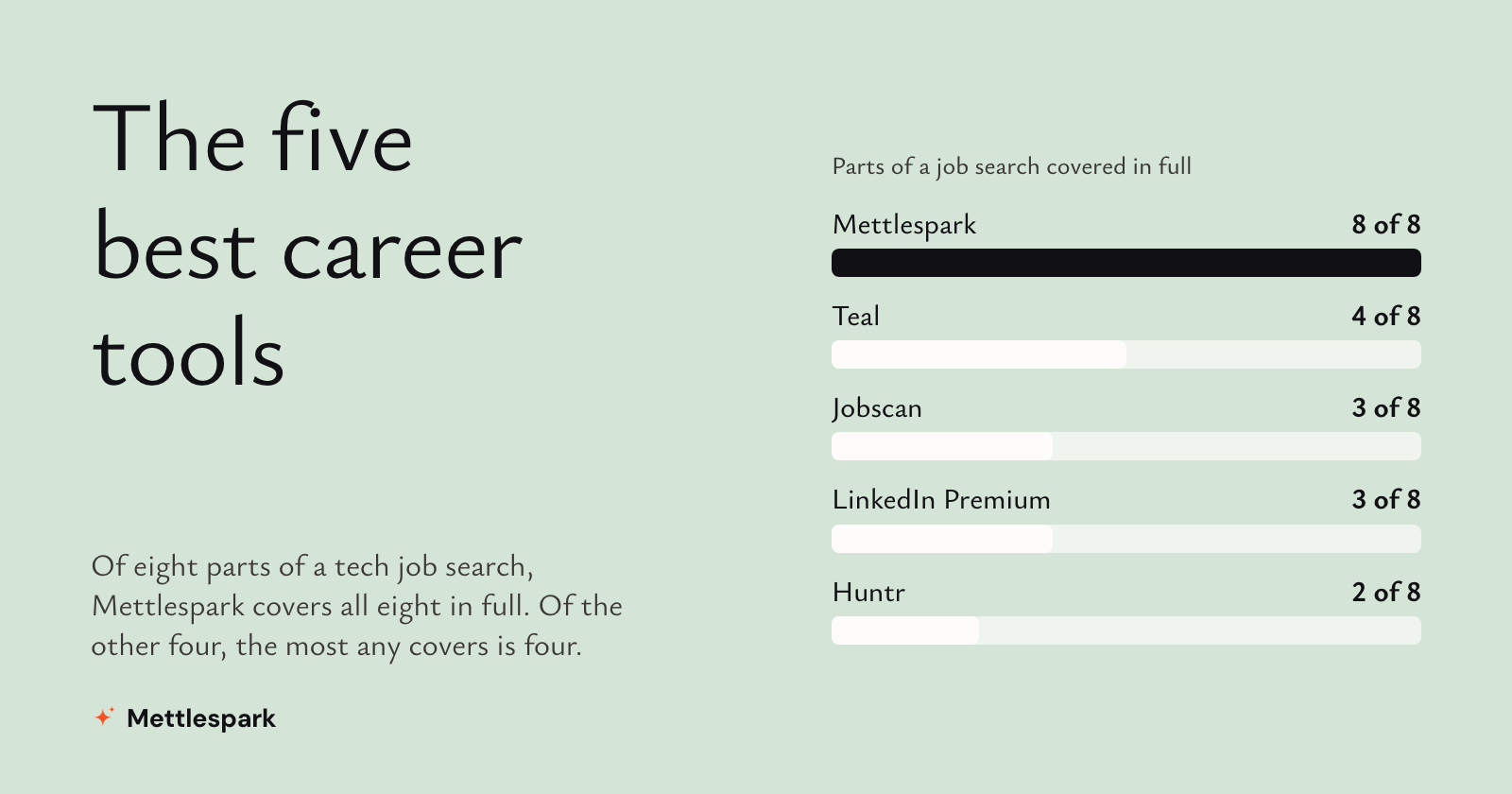
It's the only tool on this list that covers every part of a job search, and during early access every part is free, Mettlespark AI included, with no card. Of the eight parts in our comparison of ten tools, Mettlespark covers all eight in full; of the four below, the most any covers is four.
2. Teal: building a resume and tracking applications
Best for: a polished resume from a template and an unlimited free job tracker.
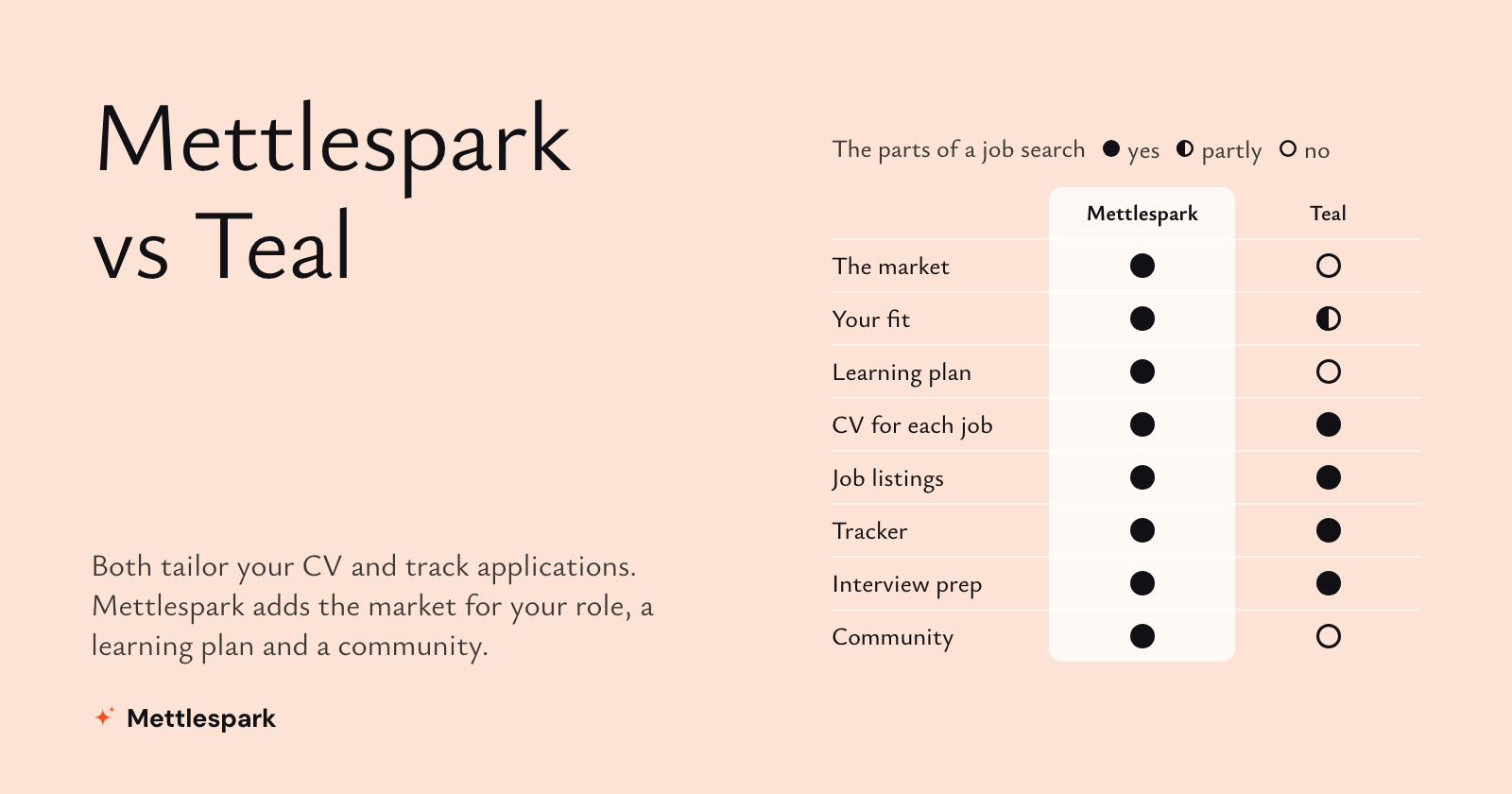
Teal pairs a resume builder with a job tracker and a tech job board. Its AI writes bullets, summaries and cover letters, its Match Score compares a resume with one job description, and its AI mock interviews work from your saved jobs. Teal+ is $29 for 30 days. It covers four of the eight parts in full; it doesn't tell you what the market for your role asks for, or plan how to close the gap. Mettlespark vs Teal
3. Jobscan: a keyword check against one job ad
Best for: checking a resume against one specific job description before you apply.
Jobscan's Match Rate compares your resume with one job description, with keyword and ATS findings, and its LinkedIn Optimizer scans your profile. It's $49.95 a month after 5 free scans, and interview practice is an add-on. It covers three of the eight parts in full. Mettlespark vs Jobscan
4. LinkedIn Premium Career: reaching the people hiring
Best for: reaching recruiters and hiring managers directly.
Premium adds InMail, a year of profile viewers, Top Applicant jobs and LinkedIn Learning's courses to the network. It's $39.99 a month. It shows who is hiring, not which skills their job ads ask for, and it has no CV editor. It covers three of the eight parts in full. Mettlespark vs LinkedIn Premium
5. Huntr: organising a large search
Best for: keeping many applications, contacts and notes in one tracker.
Huntr is a tracker and contact CRM with a resume builder, a job clipper and free autofill. Pro is $40 a month, with no free trial. It has no job listings of its own and covers two of the eight parts in full. Mettlespark vs Huntr
How we chose
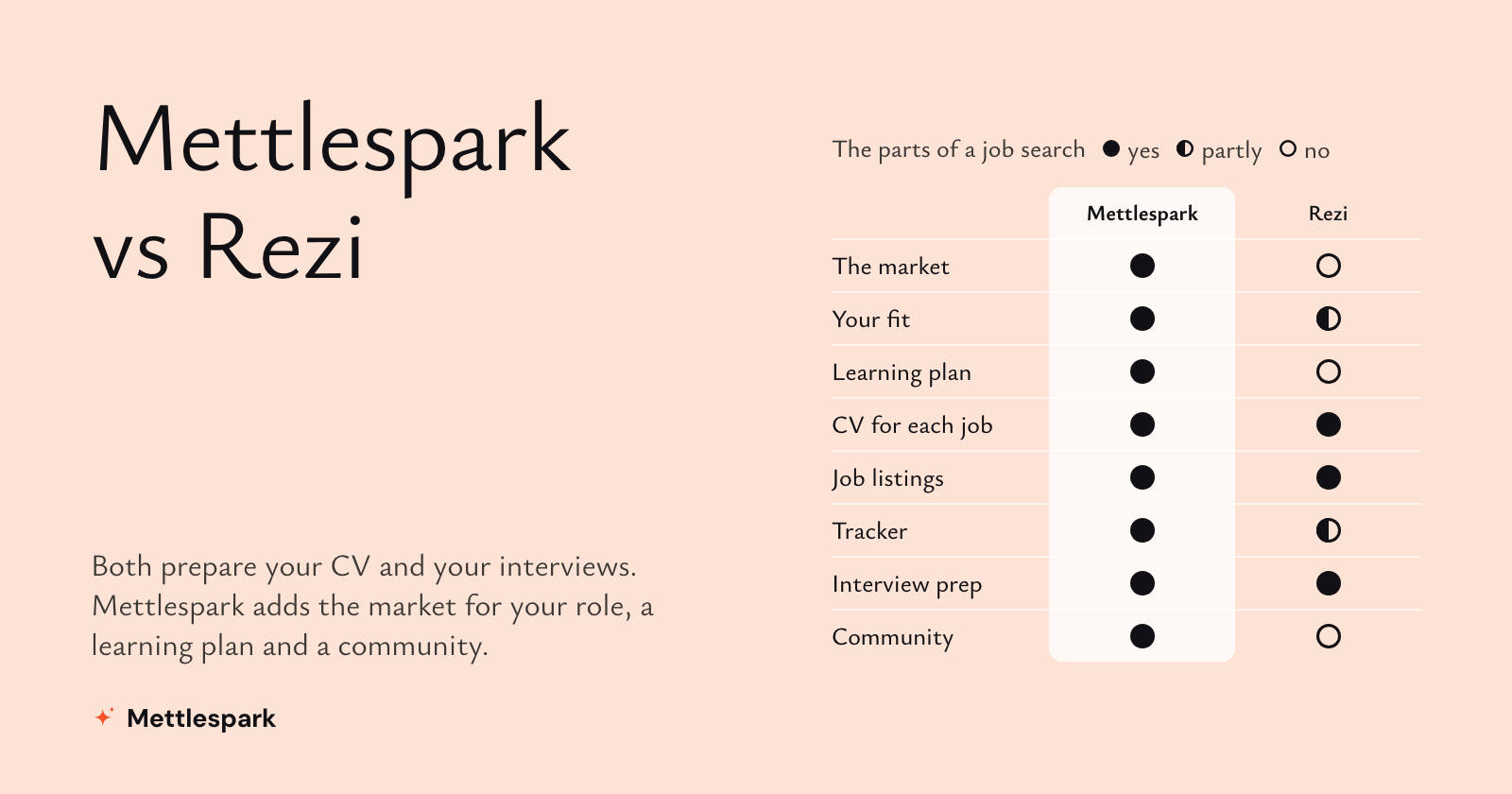
We looked at ten tools against the eight parts of a tech job search: the market for your role, your fit, a learning plan, a CV for each job, job listings, tracking, interview preparation and community. The full table, with Rezi, Simplify, Careerflow, Career.io and Final Round AI too, is in Ten career tools, compared.
The short version
If you use one tool, use the one that covers the whole search: start with your role's market on Mettlespark, see where your CV stands, and follow the plan from there. If you want more reach, add LinkedIn to contact the people hiring.
Sources, read 13 November 2026: Teal pricing, Teal interview practice, Jobscan plans, Jobscan interview practice, LinkedIn Premium Career, Huntr pricing.